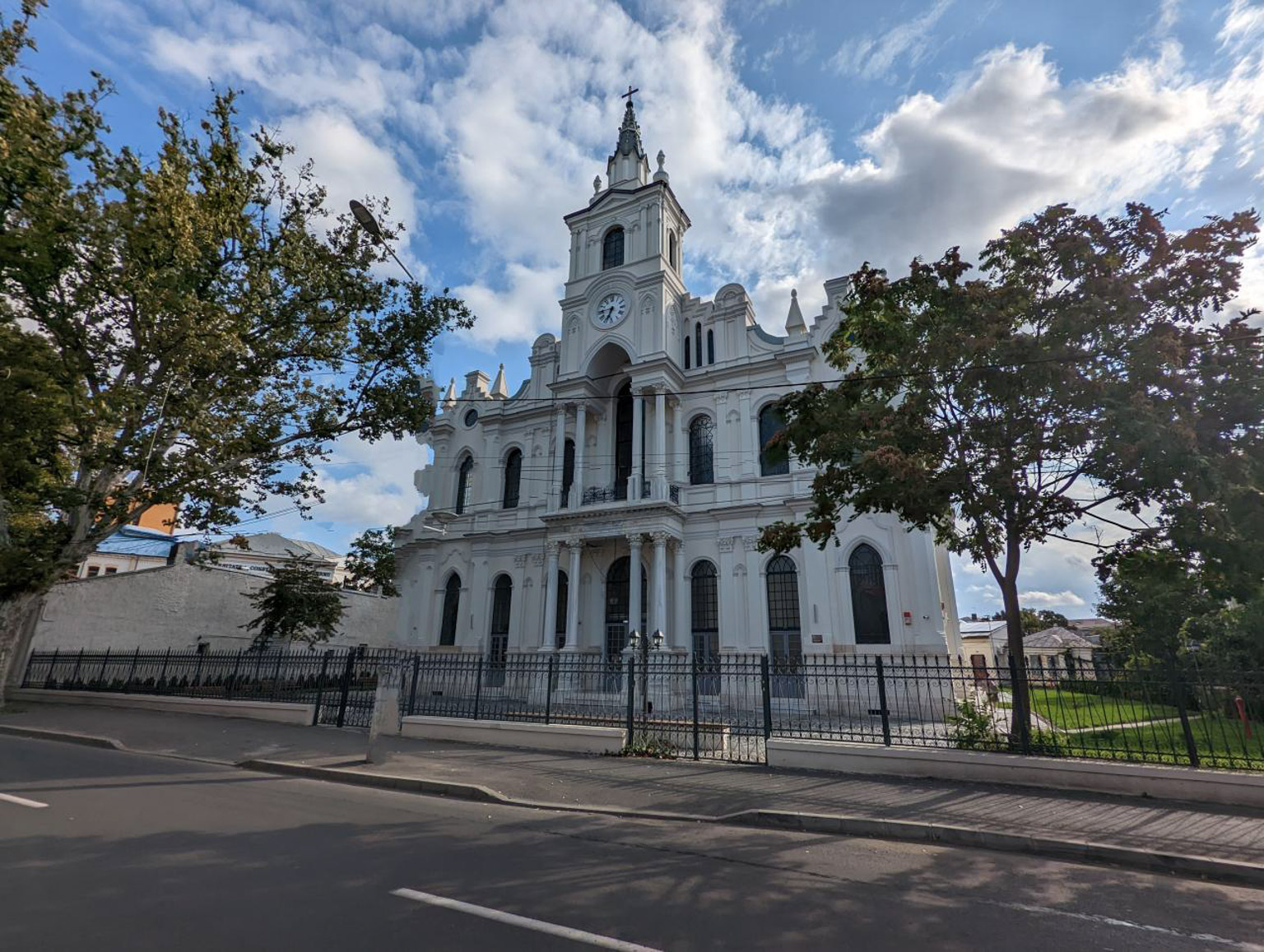
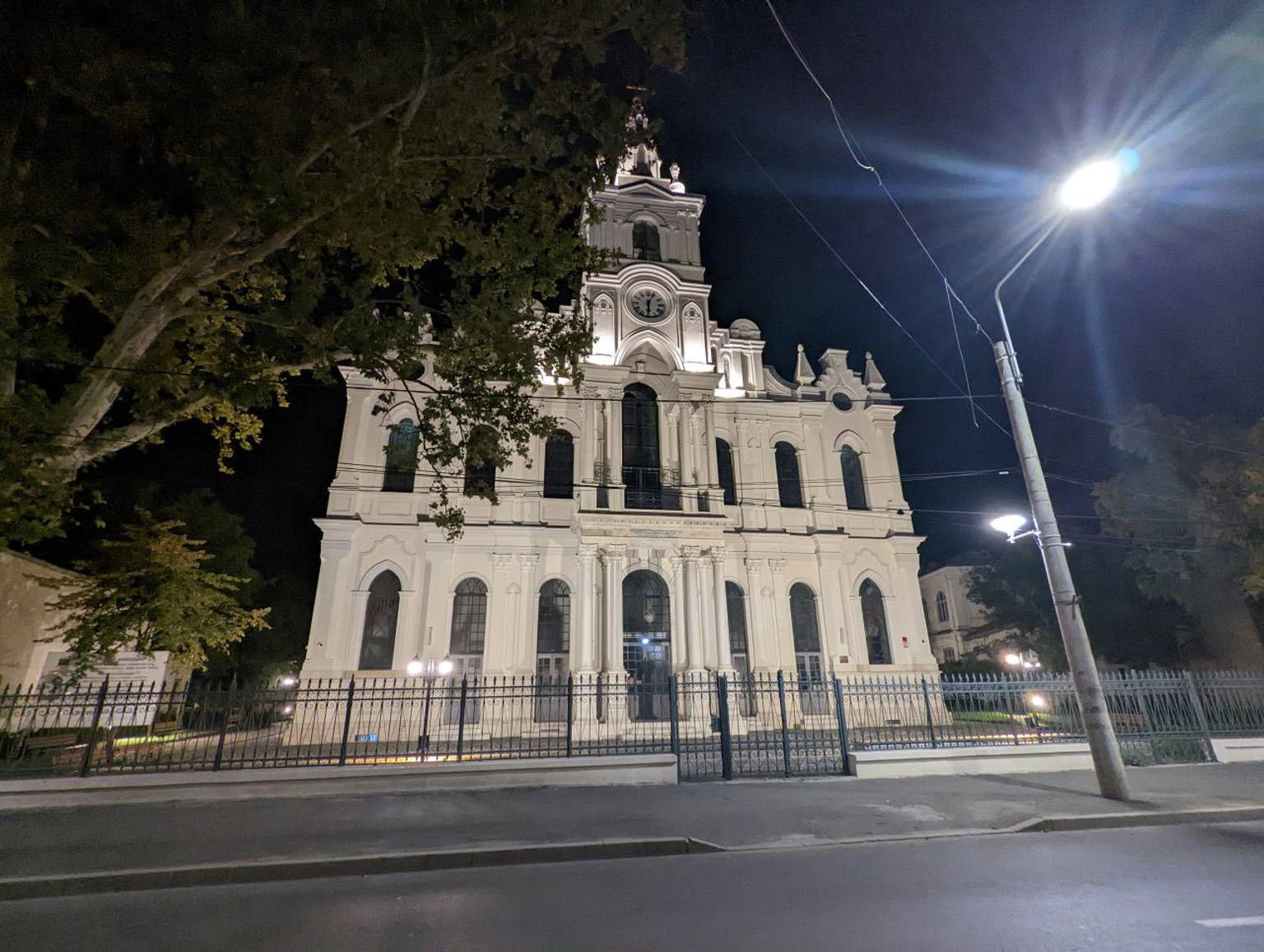
The history of the Greek Church in Brăila begins in the middle of the 19th century, linked to the local Greek community. Originally there was a small wooden chapel on the site of the church, where the Greeks from Brăila and the sailors lit candles. In February 1863, a committee of 311 Greeks decided to establish the Hellenic Community, with the main objective of erecting a church. Prince Alexandru Ioan Cuza approved the request, and on September 8, 1863, the foundation stone was laid.
The plan of the church was made by the architect Avraam Ioanidis from Brussa and the works, executed by Italian craftsmen, lasted nine years. The church is built in the Byzantine style with ancient Greek and Renaissance influences, having a round dome and a cross-shaped plan with two towers.
The building measures 43.40 m in length and 21.55 m in width. The entrance is through a porch with a balcony and four white marble pillars, and the belfry has a Swiss clock and a large bell, donated by Gheorghis Simon. The interior features a central Byzantine dome, supported by four white marble columns, and a large balcony for the church's choir.
The church has three altars: the central altar dedicated to the Annunciation, an altar in the south dedicated to St. Nicholas, and another in the north in honor of St. Gerasim of Kefalonia, under which there is a spring with miraculous water.
The interior decoration was done between 1871 and 1872 by several Italian artists, and the painting in three stages by Gheorghe Tăttărescu, Constantinos Livadas Liochis and Belizarie. The gold leaf casket was made by specialists in Constantinople and painted by several artists. At the entrance there is a large Murano crystal chandelier and other Bohemian crystal chandeliers.
The church was consecrated on October 29, 1872 by Bishop Melchisidec of Lower Danube. The Healing Spring, discovered in 1863 under one of the altars, is considered to produce aghiasma only on one day a year, after Easter.
In the last century, the church had a boys' school built in 1902. The bell tower was damaged in the earthquakes of 1940 and 1977, but was later strengthened. In 1974, the Greek Church became a parish church, services being held in Romanian. Between 2018-2021, the church went through an extensive process of consolidation and restoration, part of a 5 million euro European project. The 3000 square meter painting is being restored under the direction of the painter Sandu Stoleru.
Sursa: www.muzeulbrailei.ro