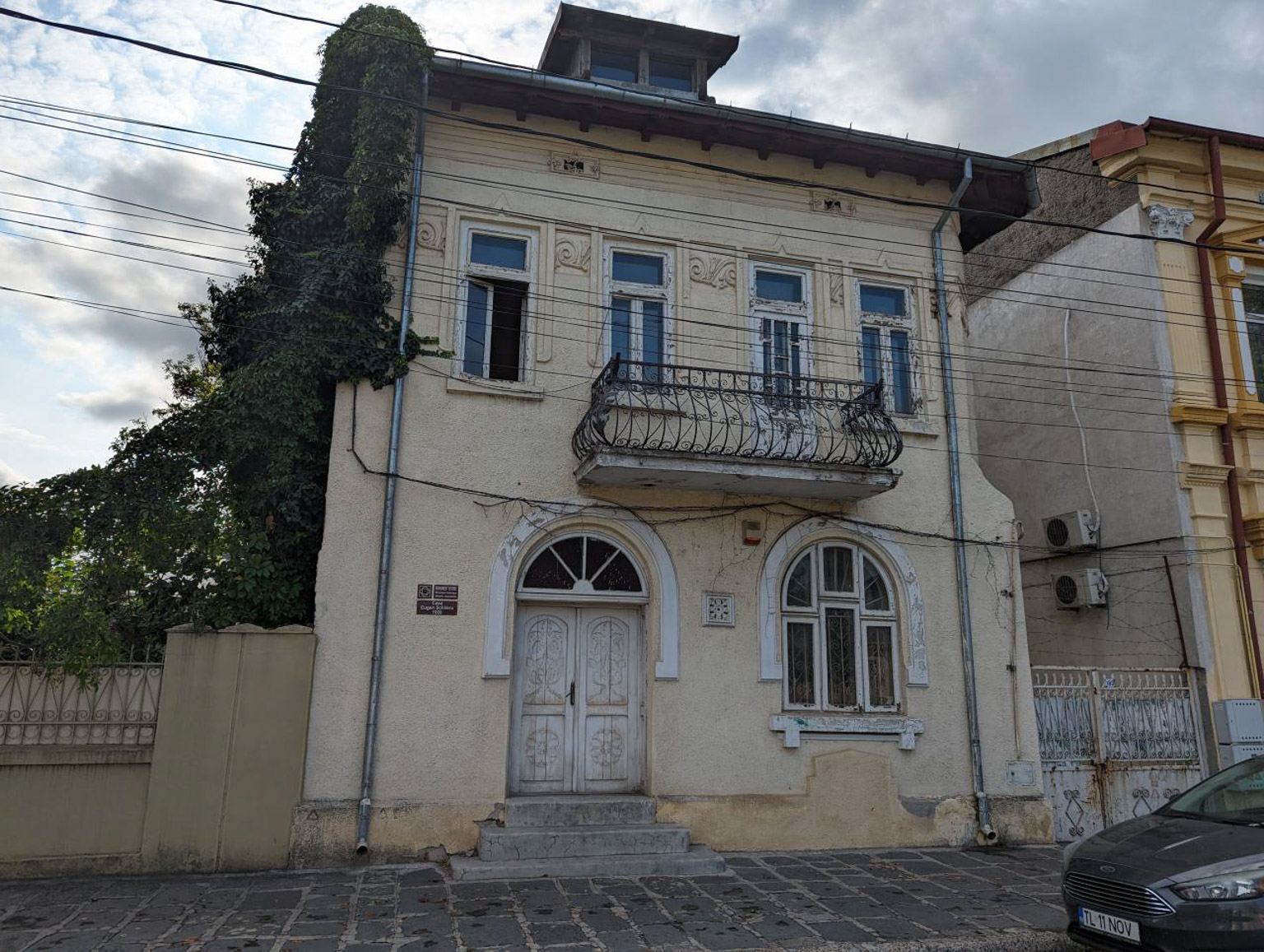
Eugen Schileru (1916–1968) was a Romanian essayist, art critic and translator, noted for his valuable contributions to the field of aesthetics and art history. Born in Brăila, he attended the "Nicolae Bălcescu" High School in his hometown and was actively involved in the local press since his adolescence, collaborating with publications such as "Columna lui Traian", "Premergătorul" and "Tribuna". It is possible that he participated under a pseudonym in the editing of the magazine "Stilet". In 1934 he became a student of the Faculty of Letters and Philosophy of the University of Bucharest, specializing in philosophical aesthetics, while also attending the Faculty of Law, which he graduated in 1939. During this period, he became involved in left-wing activities, being a member of the Communist Youth Union.
After graduating from the Pedagogical Seminary in 1939, he became a teacher in high schools in Bucharest. Between 1948 and 1951 he was director of the Library of the Romanian Academy, and from 1949 he taught the history of aesthetics at the "Nicolae Grigorescu" Institute of Fine Arts. He also taught other courses on the history of universal art, art criticism, the history of costume, ceramics, art textiles, theater, cinema and universal literature, becoming in the last year of his life the head of the Department of Art History.
Schileru made his journalistic debut in 1936 at the magazine "Era nouă", run by N.D. Cocea, writing film reviews and chronicles. After the war, he collaborated with important publications, such as "Gazeta literară", "Contemporanul" and "Secolul 20". He has produced valuable works, among which the monograph Rembrandt (1966) stands out, characterized by a persuasive style, in which the Dutch artist is presented as a "sedentary" in the spiritual universe of painting, and his color is seen as a fundamental element of the affective atmosphere. Schileru describes Rembrandt's chiaroscuro as a fluid light, capable of subtle variations, and associates the Rembrandt portrait with Pascal's definition of man as a contradictory being, in continuous transformation.
In this monograph, the author also captures the vitality of the painter in love, his directorial ability, the influences of the flamboyant Gothic and the proximity to the Caravaggist Baroque. Schileru's style becomes lyrical in passages such as the one about the painting The Storm, in which he evokes an atmosphere of cosmic catastrophe. He also quotes poets contemporary to Rembrandt, who dedicated works to the artist.
Schileru's premature death left several projects unfinished. Thus, in the monograph Impressionism (1970), the movement is analyzed both pictorially and spiritually, following the interpretations of Marcel Proust. Despite its fragmentary nature, the study highlights a remarkable stylistic clarity in the presentation of pictorial techniques and in the analysis of the aesthetic phenomenon.
Posthumously, the volume Love Letter (1971) brings together essays and reviews on art. The essay that gives the book its title highlights Schileru's cautious style towards rigid definitions, which he considers sources of error, preferring nuanced approaches. He observes, inspired by Claude Lévi-Strauss and other thinkers, that artistic metaphor can conjure up reality. Nevertheless, Schileru risks a comparison between the artistic act and a love letter, proposing three analogous models of creation, all of which have as their premise the relationship between creator and recipient. Even though he recognizes the limits of this analogy, the essayist argues that modern art, alienated from capitalism, reflects the impossibility of authentic communication.
In other texts, Schileru analyzes the issue of color, initially technical, in order to transform it into an essay on the cultural symbolism of color. In the study Tradition, innovation and critical spirit, he distinguishes between art about art and art about life, considering that, although the former can lead to fragmentarism, both can contribute to the spiritual edification of man.
Among the personalities analyzed are Theodor Pallady, Nicolae Petrașcu, Ștefan Ciucurencu, Corneliu Baba, Brâncuși and others, whom he presents with sensitivity and depth. Other texts, collected in the volume Preludii critice (1975) by Andrei Pleșu, contain theoretical preliminaries of a modern history of art, Schileru aspiring to an archaeological criticism that is both demanding and empathetic.
Finally, in the volume Scrieri (IV, 1968), Schileru sketches a spiritual portrait of the poet Dan Botta, dismantling simplifying critical labels. He presents Botta as a discoverer of archetypes and essences, linked to the vocation of Romanian classicism and an ordering vision, close to the ideal of original unity. Thus, Eugen Schileru remains an important name in Romanian art criticism and aesthetics, recognized for the subtlety, depth and clarity of his interpretations.
Sursa: cjbraila.ro