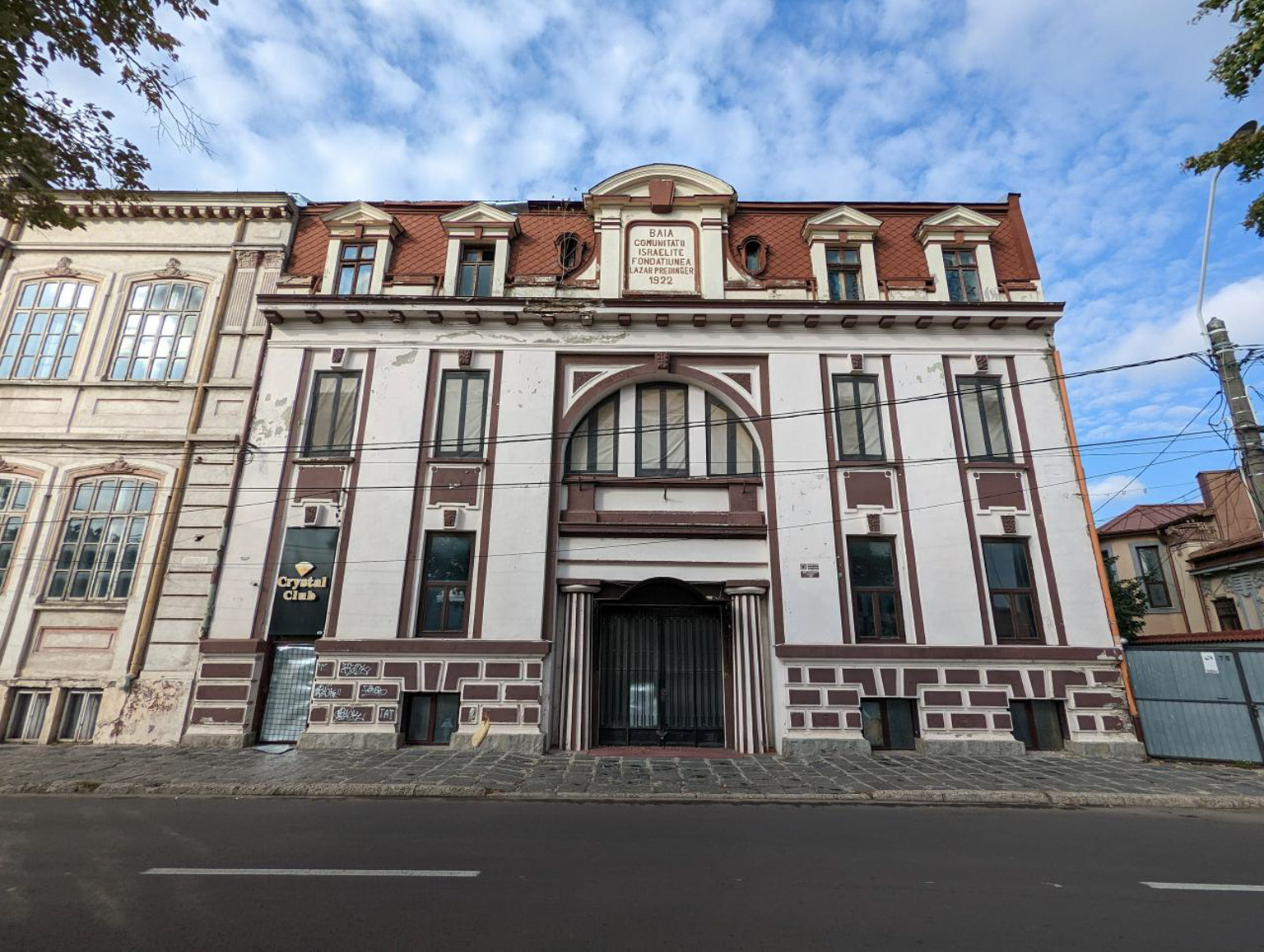
The building's facade is notable for its generous dimensions and a sober, balanced and symmetrical architectural style. The main entrance is accentuated by the presence of two massive columns, inspired by ancient Egyptian architecture. On the second floor, a large, arched window serves to visually create a vault, uniting the two vertical columns. The opening of the facade is marked by vertical rows of windows, which are terminated at the top by a triangular pediment, located on the attic windows. The composition of the building is balanced, with carefully calculated proportions and an elegant play between solid and glazed surfaces. Some details, such as the elongated shape of the windows and the rhythmic alternation of vertical and horizontal voids, are reminiscent of the aesthetics of the Secession style.
The Israelite Community Bath, also known as the Modern Bath or the Communal Bath, was a public bath established, administered and maintained by the Jewish Community of Brăila. The original inscription can still be seen on the frontispiece of the building today: *Israelite Community Bath, Fondațiunea Lazar Predinger 1922.*
Lazar Predinger, a well-known local industrialist, is the one who founded this institution. From an advertisement published in the *Anuarul Brăilei* in 1913 we learn that he owned the “First factory and distillery of spirits and lumber mill on Islazul Brăilei” (in the current area of Laminorul-Radu Negru). His enterprise had been awarded important distinctions: the first class gold medal at the National Exhibition of 1893 and the first prize at the Brăila City Hall Exhibition of 1899.
In 1921, Lazăr Predinger officially donated the land and a sum of money to the Jewish Community, a gesture sanctioned by an authentication act at the Brăila Tribunal with no. 3467/921 and confirmed by High Decree no. 262 of January 22, 1926. The documents record that, noticing the lack of a public bathhouse in the city of Brăila and wishing to provide support to the community of which he was a part, Lazăr Predinger initiated the construction of such a building. He thus donated a plot of land located on Cuza Boulevard, at no. 63, and the amount of 130,000 lei, intended exclusively for the construction of a modern bathroom, also equipped with a ritual bath *Mikvah*, dedicated to the observance of religious purification rituals for the faithful Jewish members of the community. The building was built with the support of the community and the city's residents, the total value of the investment exceeding ten million lei. At the same time, out of the desire to help needy children, the founder also financed the establishment of a cafeteria that would provide daily meals for approximately 100 students.
In gratitude for his gesture, the community decided that this institution would bear the name of the founder: Baia Lazar Predinger.
The construction of the building was carried out in 1922, using materials such as stone, reinforced concrete and brick. The building had a basement, ground floor and first floor. In the basement there was a steam bath for the second grade, two locker rooms, a shower room with a cold water pool, a room with six bathroom cabins equipped with bathtubs and a spacious hall. On the ground floor and first floor there was a reception room, a hairdressing and pedicure salon, the bathhouse's administrative office, locker rooms, shower rooms, a hot water pool, two steam rooms, another cold water pool, a massage room and a hall with toilets. The building was connected to the electricity, running water and sewage systems, being one of the most modern buildings of its type at that time.
In 1940, in the context of social and political unrest, under pressure from local authorities, the Jewish Community was forced to cede the bathhouse, along with the entire inventory, land and related facilities, to the Brăila City Hall. This forced transfer was carried out through a report authenticated by the Brăila County Court, Section 1, with no. 2256 dated December 10, 1940. Following the takeover, the building passed into the administration of the local authorities and has operated since then under the name *Baia Românească*.
The construction of the building was carried out by the founder's son, architect Iancu Predinger, who translated his father's project into reality, both technically and aesthetically.
As for the ritual bath *Mikvah*, in Jewish tradition it represented a space for religious purification, through complete immersion in natural water or "living water". The purification ritual took place before religious holidays or at other important moments in the spiritual life of the community members.
A notable event took place on June 8, 1924, when the guardianship of the Israelite Community requested military music for the official inauguration of the bathhouse on Cuza Boulevard no. 63. The ceremony took place on Sunday, June 15, with a musical program between 10:00-12:00 at the bathhouse headquarters and between 20:00-22:00 in the Suzana Garden, where the 38th Regiment brass band was present.
Sursa: www.facebook.com