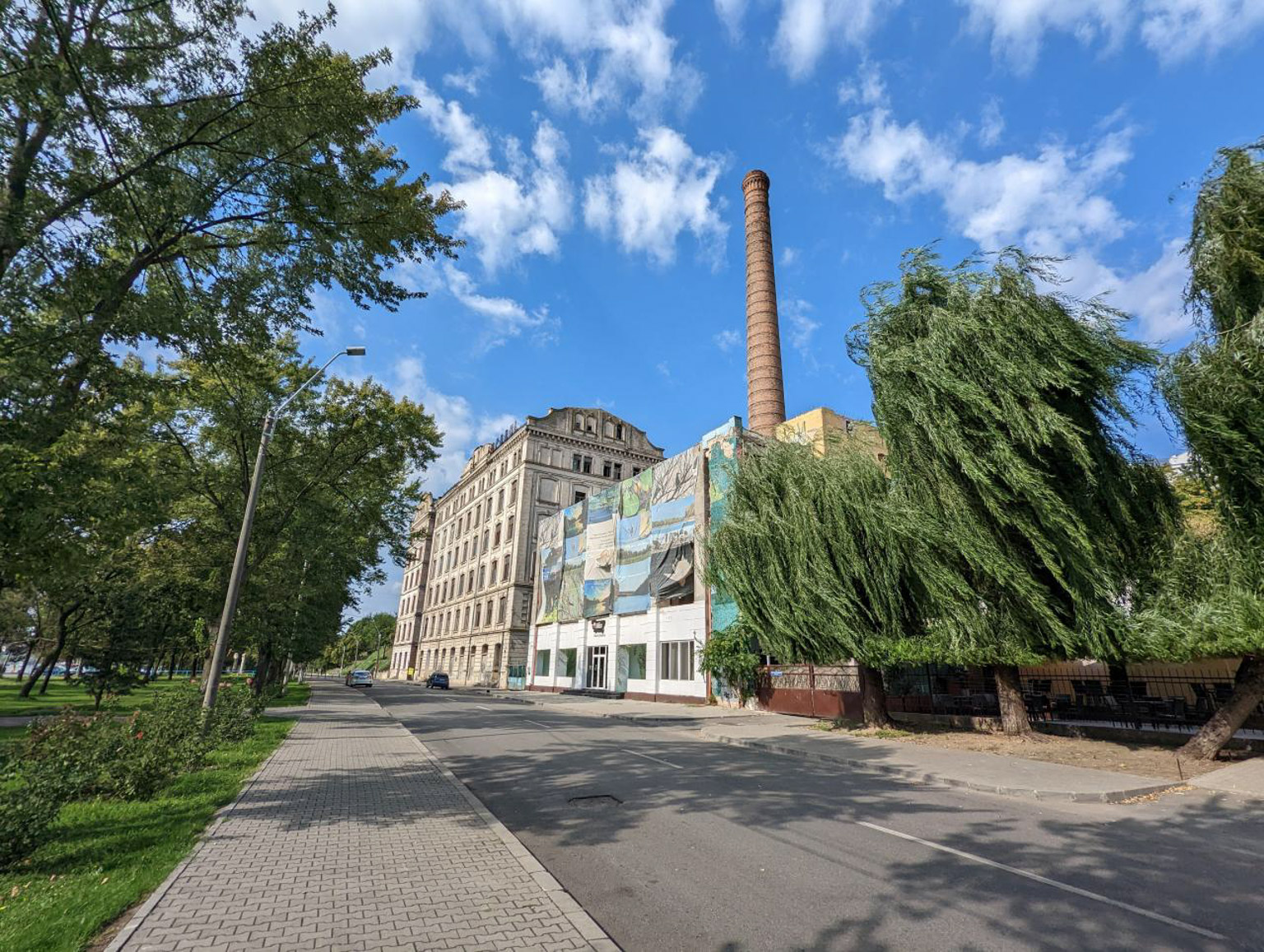
On the banks of the Danube, in Brăila, lie the ruins of the largest steam mill in southeastern Europe – the Violatos Mill. Built in 1896 according to a project signed by the famous engineer Anghel Saligny, the building was once a symbol of the city’s prosperity and the economic power of the Greek community settled in the area.
The story of the mill is closely linked to the Violatos family, Greek merchants who settled in Brăila around 1800. With a solid reputation in the grain trade, they invested in the industrial development of the city, building one of the most modern and imposing steam mills in Europe at the time. The building not only impressed with its technology, but also with its monumental architecture, visually dominating the city and symbolizing its prosperity.
Along with the Valerianos & Lykiardopoulos Mill, the Violatos Mill was part of the impressive industrial landscape of Brăila. According to historian Ioan Munteanu, the Panait Violatos flour mill was considered “the most imposing and perfected installation in the whole country and, probably, in the whole East.” Technologically, it was an advanced, electrically powered construction, capable of rapidly processing large quantities of grain, with a production of up to 150 tons of flour per day.
Panait Violatos, the name behind the mill, was a prominent figure in the business world of Brăila. Before building the mill that bears his name, he was associated with Iani Millas, another Greek industrialist. The relationship between the two deteriorated, and Violatos decided to build a rival mill, even attracting employees from his former collaboration and associating with the nephew of his former partner, Iani Valerianos.
The mill was built without the approval of the municipal council, despite objections to its location on the banks of the Danube, but it quickly became an industrial colossus. The construction was carried out on wooden pillars fixed in clay soil and reinforced with concrete, using modern materials for the time, including cement produced at the local Cantacuzino factory. The grain supply mechanism was extremely efficient, with wheat being brought directly from barges through an underground canal.
Since 1912, the mill has been connected to the railway, and in 1921 its working capital was 20 million gold lei. Equipped with 1,200 HP Gottlieb Luther engines, which consumed eight tons of fuel oil daily, the factory benefited from energy autonomy and state-of-the-art technology. Qualified personnel were brought from abroad, and the flour obtained, of high quality, was mostly intended for export.
The decline began in the 1940s, when financial difficulties led to bankruptcy. In 1944, Soviet troops dismantled the installations and transported them to the USSR. In 1948, the Romanian state took over the mill under sequestration, and the building was nationalized. Although it lost its original function, it continued to be used economically until 2000.
The Violatos Mill was classified as a historical monument in 2004, being included in the protected urban heritage of Brăila. Although the mill facilities were decommissioned, the building retained its exterior architectural expressiveness. The restitution process initiated by the heirs of the Violatos family ended after more than ten years, they opted for financial compensation instead of the land, including the land under the mill.
Despite its historical and architectural value, the Violatos Mill is today in disrepair. Although the Braiconf company considered buying it to relocate the shirt factory, it ultimately chose another location. Thus, the mill remains uninhabited and up for sale, a neglected heritage monument, "abandoned, lugubrious", as journalist Adina Popescu describes it. It is a page of industrial glory, today transformed into a shadow of its glorious past.
Sursa: artaalba.ro