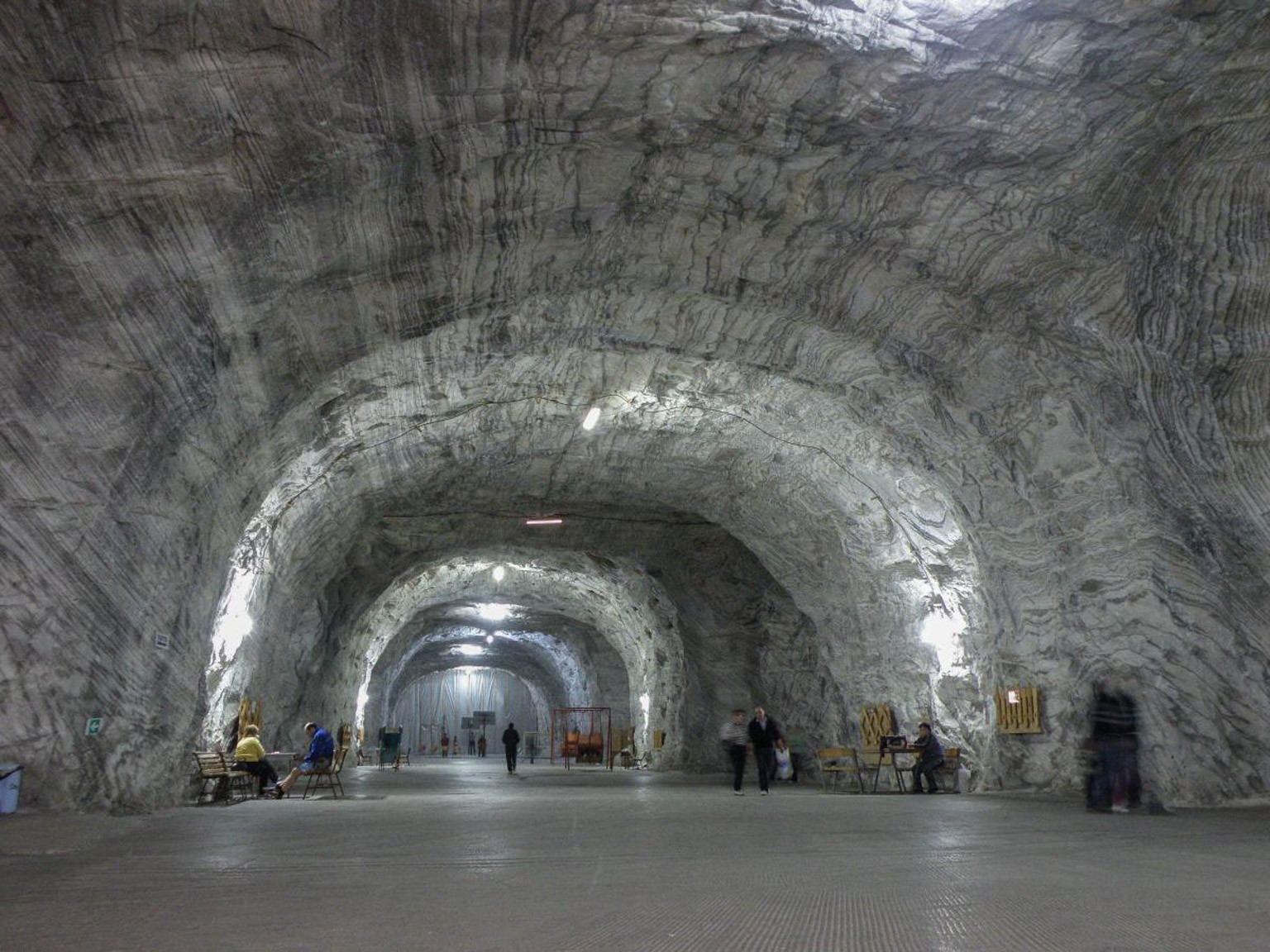
Millions of years ago, between the Oligocene and Miocene, there was a lagoon in these places where the first cubic salt crystals were formed. During the periods of deposition, the climate underwent slight changes: white salt is the barometer of warm weather with low precipitation and high concentrations, and gray salt corresponds to the season of abundant precipitation.
The deposition of the salt banks was followed by other sediments that covered the gray-white strata. The orogenic movements influenced the formed layers, giving them the appearance of a lens, in some places faulted. People, tireless explorers, tunneled deep, extracting the salt little by little.
The story of salt begins at the Oligocene-Miocene boundary and continues today. Placing the beginnings of salt exploitation in the area of the town of Tg.Ocna is difficult due to the lack of documents. Alecu Obreja mentions that the exact date of the opening of the salt mines in Moldova cannot be specified, but it is known that the natives used the salty springs and the salt from the outcrops since very ancient times.
The oldest written evidence dates back to 1380 and consists of a royal charter attesting the payment of 2000 ocales of salt for the construction of a bridge. The income of the mines was obtained at the expense of the Trotuș residents, the first miners who exploited the mines at their own expense. The first exploitations were located in the Oituzului valley, around the commune of Grozești.
In the 15th century, the hills of Carbunaru, Cireșoaia, Măgura, Podei, up to Tg.Trotuș were covered by forests where outlaws and robbers had their abode. Legend has it that an outlaw chased by the potera discovered a pit of salt.
Between the years 1407-1434, the camarasia of the windows was located at Tg. Trotuș. In 1434, the camarasia moved permanently to Tg.Ocna. During the reign of Ștefan the Great, the exploitation of salt experienced a significant development, and the ruler strengthened the privilege of the Putna monastery to be supplied with salt from Târgu Ocna.
The exploitation of salt in the region of Trotușului and Tg.Ocna was done by the locals for their own consumption, and the surplus was sold. Part of the production of the mines went to the consumption of the monastic servants, known as vajnici salt fish consumers.
Dimitrie Cantemir, in "Description of Moldova", mentions the rich salt mines near Trotuș, emphasizing that the salt is found clean and clear at shallow depths and that the mines are not dry, although hundreds of people worked in them daily.
Salt was mined in the area in bell-shaped kilns until the second half of the 19th century. Ocne, such as Ocna Grebleș, Ocna Surpată and others, form a series of underground hollows between the Grebleș stream and the Trifu stream.
In the 18th century, ocna workers were of two categories: free workers (ocolasi and salagi) and criminals (ocnasi). Working conditions were difficult and access to the furnace was difficult due to the great depth.
Ruler Grigore Ghica ordered the establishment of a solid prison for Ocnași, in order to improve their working and living conditions, the edifice being named "Ocnașilor Castle" and completed in 1855.
Until 1800, work was done in the Tâlhari kilns and Ocna cu Brad. After this year, exploitation expanded to Ocnele Unite. In 1850, exploitation began at Ocnița, and working conditions remained difficult.
In 1875-1881, at Tg. Ocna used a steam powered extraction machine. In 1881, a great flood forced the abandonment of this machine. In 1891 a new steam powered extraction machine was put into operation.
The transport of salt was carried out by carriages and on horse saddles, and after the inauguration of the railway Adjud-Tg. Ocna in 1884, salt was transported to the railway station by wagons. From 1885 to 1896, the transport was done by funicular.
In 1896, the railway was extended to the salt sheds in the Tg salt pan. Ocna. Anghel Saligny designed and built the first funicular in Romania, which operated for 11 years, transporting about 10 wagons of salt daily.
In 1891, vertical transport was replaced by horizontal transport through a coastal tunnel. In 1891, the G401 gallery was put into operation, and Tg.Ocna became a town due to the importance of mining.
The town of Tg.Ocna prospered thanks to the salt mines. Renowned researchers have studied the salt deposits, determining their age. Costache Negri, although not born in Tg.Ocna, linked his activity to this city, where he built several houses and spent his last moments of life.
The system of underground felling by ogival-ended shafts lasted until 1870, when large trapezoidal chamber workings began to be opened. The Old Moldova Mine was mined by hand between 1870-1941, and from 1931 narrow gauge railway lines were installed to transport salt.
The system of underground felling by ogival-ended shafts lasted until 1870, when large trapezoidal chamber workings began to be opened. The Old Moldova Mine was mined by hand between 1870-1941, and from 1931 narrow gauge railway lines were installed to transport salt.
The opening of the Moldova Nouă mine began in 1936, operated until 1968. The Pilot mine, opened in 1967, operated as a tourist base between 1974 and 2005, treating various ailments. The first salt museum was also located here.
In 1966, the works for the opening of the Trotuș mine began, and in 1982 the opening of the Unirea gallery for the transport of salt began. In 1985, the gallery was put into use, facilitating the transport of salt to the lower floors of the Trotuș mine.
Currently, salt mining is carried out on the X and XI horizons of the Trotuș mine, and the tourist activity is concentrated on the IX floor.
Sursa: salina.ro