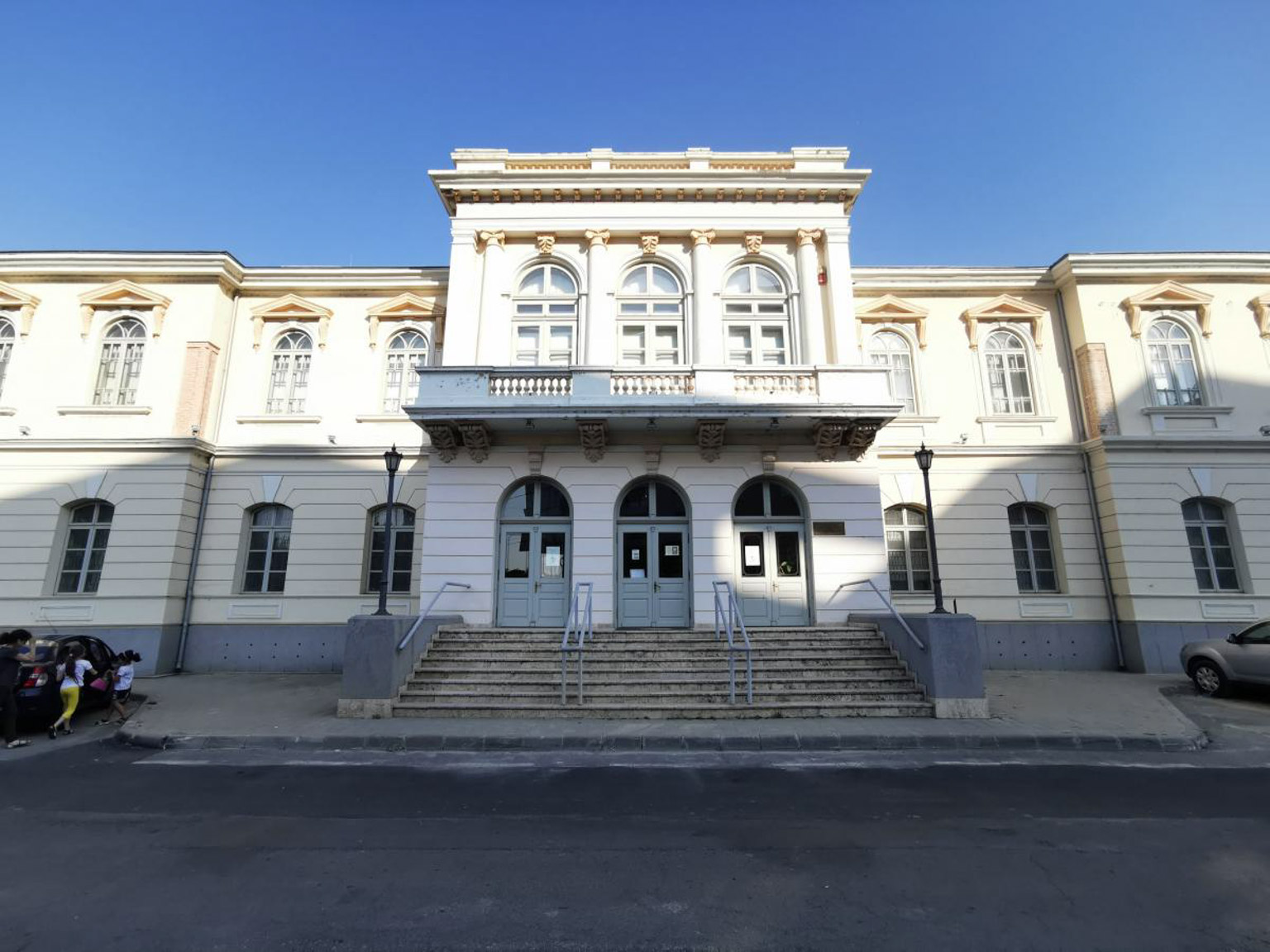
The museum is housed in the Pasha Palace, built around 1870 by Ismail Pasha. At that time, the Danube River stretched to the main entrance of the building. To prevent lateral settlement, the edifice was placed on a pyramid-shaped foundation with the top pointing downwards. During the communist period, this place housed the county prefecture, followed by the people's council.
The Arts Section presents artistic creations in painting and graphics inspired by the beauties of the Delta and Dobrogea in general, signed by outstanding Romanian artists from the interwar period and the beginning of our century. Many of them have origins in Tulcea.
In contact with icon artists with Byzantine tradition, the first plastic artists from Tulcea were church painters: Mihail Paraschiv, specialist in portraits and later the mentor of master Alexandru Ciucurencu, as well as Enache Cardaș, expert in mural painting, author of the numerous frescoes in churches that remain today testimony to his craftsmanship (such as the church of St. George and the church of St. Nicholas in the city).
Gh. Sârbu (1883-1956), a native of Tulcea, with a lyrical temperament and a remarkable sensitivity, captivated by the beauty of the deltaic landscape, transposed in his works, through the use of discreet chromaticism and a precise drawing, images of a lyrical depth on the theme of the human-nature relationship.
Stavru Tarasov (1883-1961), another painter originally from that region, born in Letea, in the heart of the Delta, showed remarkable skills even during his studies at the Academy of Arts in Munich, being considered one of the most talented draftsmen, according to his testimony N. Tonitza. After completing his studies, he devoted himself to portraiture and landscape.
In the field of sculpture, during that period, the figure of Vasile Chiriachide (1886-1926) is distinguished, especially through his sculptures exhibited outdoors.
The painter Vasile Pavlov, born in Tulcea in 1900 and died in 1972, showed a deep passion for the delta, which he translated into a plein-airist perspective in his artistic works.
Geo Cardaș, a graduate of the School of Fine Arts in Bucharest and the Free Academy in Paris, thematized in his paintings the diversity of aspects captured from the surrounding reality. His images include urban or harbor landscapes, portraits and compositions with social connotations.
Alexandru Ciucurencu, born in Tulcea in 1903, began his artistic training at the Fine Arts School in Bucharest, under the guidance of Professor Camil Ressu, then continuing in Paris in the studio of André Lhote. From an early age, Ciucurencu showed an innovative talent and made significant contributions to the evolution of Romanian art, being known for his virtues as a colorist.
Ion Jalea, born in 1887 in Casimcea, distinguished himself as an artist with a remarkable artistic training, illustrating integrity and professional devotion. His art is oriented towards balanced forms, aiming to express the simplicity of movement and gesture. His sculptures impress with the sober use of plastic means, the deep knowledge of modeling and harmonizing details with the whole, giving unity to his entire work.
In the history of Romanian art, the role that Tulcea played as a source of inspiration in the creation of our plastic artists is recorded. There are few visual artists who have not stayed in this picturesque city, have not been attracted by the novelty, beauty and charm that the lands of Tulce generously offer. We thus remember Gh. Pătrașcu, N. Tonitza, Br. Şirato, N. Darăscu, J. Al. Steriadi, C. Ressu, St. Dimitrescu, Iorgulescu Yor, M. Bunescu, St. Popescu, H. Catargi, S. Mutzner, St. Tarasov, Rodica Maniu, Gh. Naum, A. Ciupe, I. Irimescu, S. Ionescu, Michaela Eleutheriade, I. Gheorghiu, I. Pacea, I. Bitan, their number being much higher.
Here are some titles of paintings: Piață din Tulcea, Cafenea din Tulcea, Peisaj din Delta and Turkish Glass (by N. Dărăscu); Evening at the sea, On the banks of the Danube and Evening at the shore (by Gh. Petrașcu); Landscape - Sulina, Vessels on the Danube and Sunken Ship (by M. Bunescu); Târg Dobrogean (by J. Al. Steriadi); Dobrogean landscape and Landscape with houses (by V. Popescu); In the port of Tulcea (from Gh. 31rbu); Landscape in the Delta (by St. Tarasov); Turks on the beach (by I. Iser); Dobrogean landscape (by Cecilia Cuțescu-Storck); Landscape from Dobrogea and Marina (by St. Dimitrescu); Peasants in the boat (by C. Ressu); Houses from Tulcea (by A. Ciupe); Mile 23 (by E. Popa); Canning factory in Tulcea (by I. Gheorghiu); Partisans in the Delta (of I. Peace).
Source: Danube Delta (Ministry of Tourism, 1978)