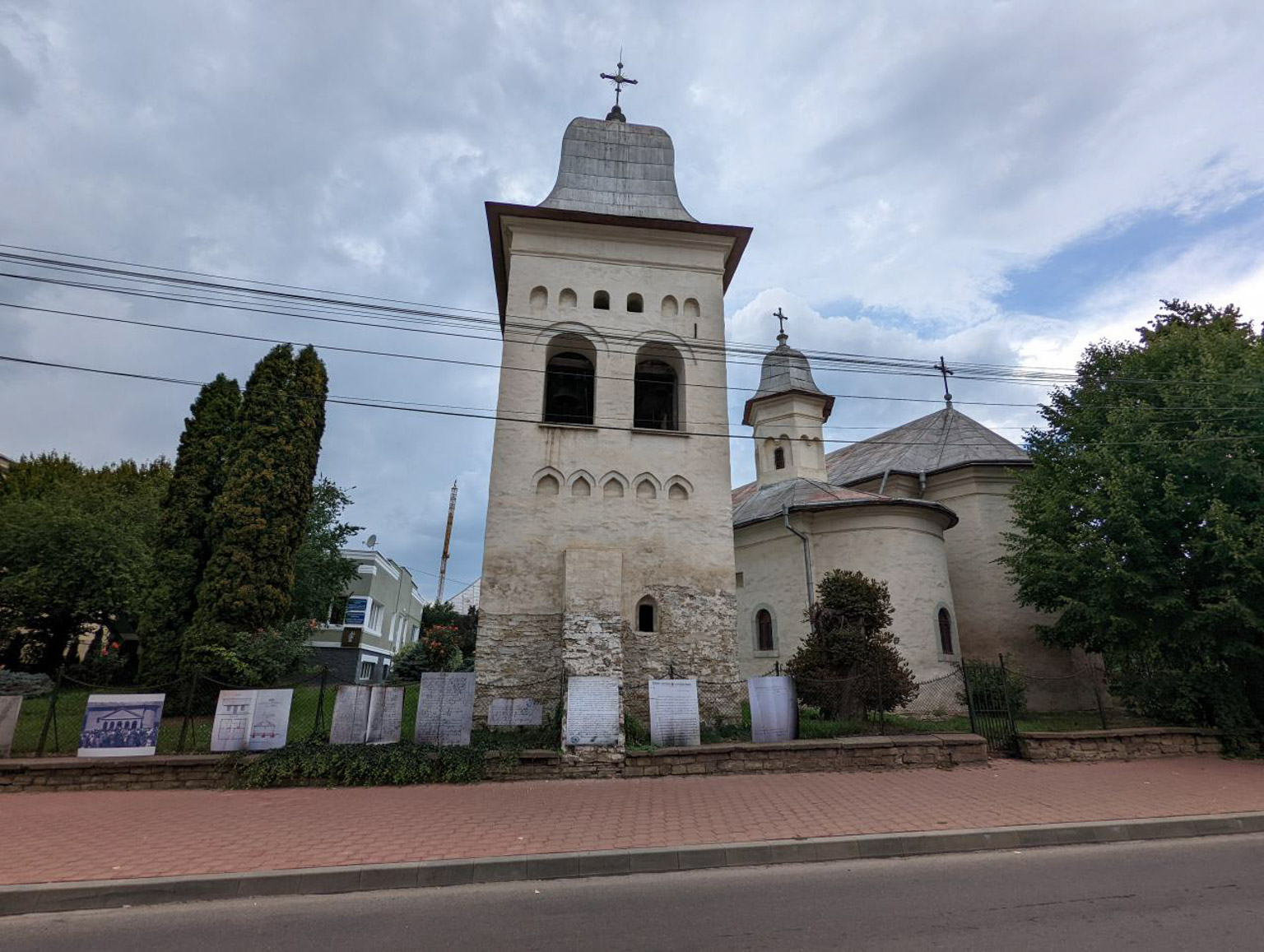
The "Holy Cross" Church in Suceava, a religious building of the Armenian community, was built in 1521 and is located on Armenească Street no. 1, near the "Saint Simion" Church, forming together a significant historical ensemble for the initial nucleus of Armenians' residence in the city. This church is listed in the List of Historical Monuments in Suceava County, under the code SV-II-m-A-05452.
The Armenian community in Suceava is of considerable antiquity, having been present since the 14th century. The Armenians settled in the area attracted by the commercial and craft possibilities, developing a specific neighborhood on the current Armenească Street. They also organized their religious life, building places of worship according to their own traditions. In 1388, a document issued by the Armenian Catholicos Theodore II placed the Armenians of Suceava under the jurisdiction of the bishopric of Lviv. However, in 1401, Prince Alexander the Good consecrated the establishment of the first Armenian bishopric in Moldavia, with its headquarters in Suceava, under the leadership of Bishop Hovhannes. Thus, the community gained religious autonomy from Lviv.
Dimitrie Cantemir mentions in his work *Descriptio Moldaviae* that the Armenians in Moldavia enjoyed religious freedom and had large and well-maintained churches. The Armenian traveler Simeon Lehati, present in Suceava in 1608, noted the existence of three stone Armenian churches (St. Cross, St. Simeon and St. Trinity) and two monasteries (Zamca and Hagigadar).
Before the current church "St. Cross", there was a wooden church on the same site. A tombstone with an inscription from 1428 confirms this hypothesis. The current stone church was built in 1521, during the reign of Ștefăniță Vodă, by Cristea Hanco (Hacih Hancoian). An inscription on the church door attests the year of construction, and in the southern wall of the nave there is a stone inscribed in Armenian with the year 1521. Tradition says that the founder was buried in the church, but this fact has not been proven.
Another tombstone raises questions about the founder of the church. It mentions a different year, 1606, and another name – Hagop, son of Khogea Biata. The Armenian historian H. Dj. Siruni suggested that this personage contributed only to part of the edifice or to the construction of the bell tower.
During the reign of Ștefan Rareș (1551–1552), the Armenians of Moldavia were subjected to religious persecution, as the ruler wanted to eliminate the traces of his brother Iliaș Rareș's conversion to Islam. He imposed Orthodoxy as the sole religion, and Armenians who refused to convert were persecuted, forced to leave the country or be baptized. Armenian churches were destroyed or closed, bishops and priests arrested, and liturgical books burned. However, these places of worship were later rebuilt.
In 1693, about 3,000 Armenians lived in Suceava, who had four churches and one monastery – Zamca, the bishop's residence. Each parish priest was supported by 150 families. The Church of the Holy Cross has undergone several restorations, a notable one in 1878, which gave it an appearance close to that of the Moldavian buildings of the 18th century, although it remains a place intended for Armenian worship.
The Armenian Church of the Holy Trinity collapsed at the end of the 18th century. The wife of a merchant died under the rubble, and her descendants built a chapel in 1776, in memory of the epitrop Hovhannes Capri. This chapel, dedicated to "St. John the Baptist", is attached to the southern wall of the Church of the Holy Cross.
In the churchyard, in 1824, a building intended for an Armenian primary school with four classes was built. An inscription was engraved on its pediment attesting to the educational and religious purpose of the construction.
The Armenian community of Suceava had a traditional custom, practiced on December 29, the feast of Saint James: they collected money to buy cattle, whose meat was offered to the poor in the churchyard. The custom, called Madach, comes from an old pagan ritual dedicated to the goddess Anahit and was preserved after the Armenians converted to Christianity.
At the beginning of the 20th century, the Itcani–Areni railway line passed very close to the church. In the summer of 1918, due to the tremors caused by the trains, the church steeple collapsed inside. After World War I, the railway line was decommissioned. Restorations were only undertaken in 1935, when the nave vault and altar were restored, but the steeple was not rebuilt. On this occasion, fragments of an old painting were discovered on the northern wall of the nave.
On August 11, 2007, on the eve of the feast day at the Hagigadar Monastery, a religious service was celebrated in the church by the Archbishop of the Armenian Orthodox Church in Romania, Dirayr Mardichian, along with three other priests. The church, renovated in the meantime, is active today, with services being celebrated according to the Armenian rite. Its patron saint is the Exaltation of the Holy Cross, celebrated every year on September 14.
The edifice is built to a height of 3-4 meters in stone, and the upper part is made of brick. The nave is vaulted, extended to the west with a distinct space, also vaulted, and the narthex is divided into two parts. The existence of two entrances – one from the narthex and another on the southern side – completes the structural configuration.
On the southern side, to the east, is the chapel "St. John the Baptist", attached to the church, with a rectangular shape, eastern apse and a steeple. In front of the church rises a modest-sized bell tower, supported by two buttresses. The exact date of construction of this tower is unknown, but it is known that it was restored and a tombstone was embedded in it.
The interior of the church is not painted, but the walls are decorated with Armenian icons. At the end of the 19th century, the curtain embroidered with scenes from the Holy Scripture, used to separate the altar from the rest of the church, came from this church and was kept in the "St. Simion" Church. The inscription on it mentioned that it had been made in 1761 by the singer Iacov Țințin.
At the beginning of the 20th century, an old bell was kept in the church's attic, brought by Armenians during their immigration from Armenia. Inside the church is the tombstone of Deacon Asvadur, son of Cailcea, dated 1522. He was buried at the foundation of the church, together with two other people. The tombstone was discovered in 1860 in the Sf. Dumitru neighborhood, during excavations.
The "Holy Cross" Church in Suceava remains an important symbol of the identity and perseverance of the Armenian community in Moldova, illustrating a complex history of cohabitation, persecution, reconstruction and faith.
Sursa: ro.wikipedia.org